
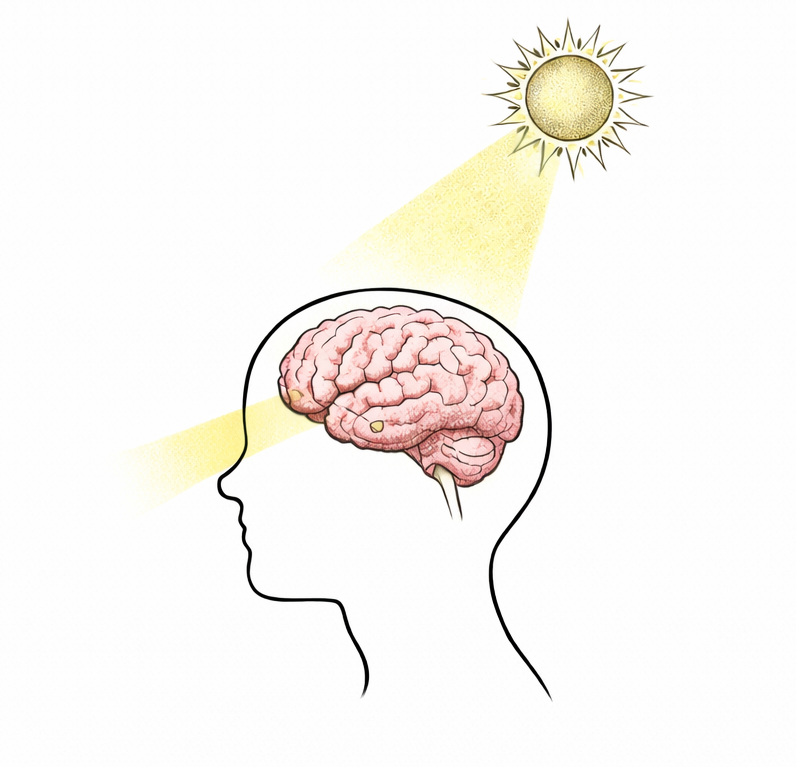
Do you remember what they thought us in school abut plants needing oxygen, water and light to grow and bloom? Interesting fact: We humans need all this as well !
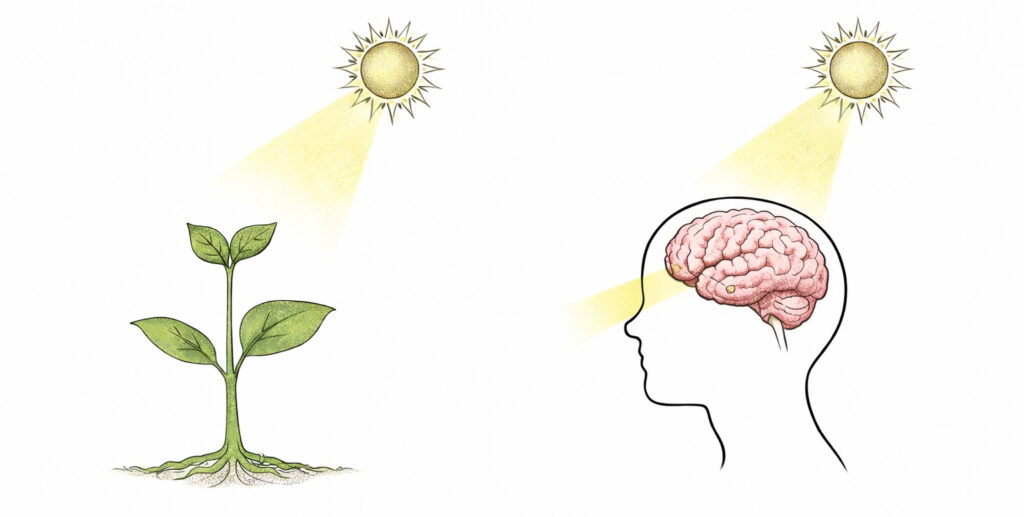
There is of course a difference between humans and plants but in the end we do both need light, to function well.
Actually you are much more connected to this planet than you might like it and the more you live with it, the better you function, and the better you function the better your body works and the better your body works.. the better you feel.
Light → Eyes → Brain
Remember, there is this clock in your brain, and the cells in our eyes, which detect light? If not, you can read about it here: Why we have to sleep.
You know what, it doesnt stop there. The rhythm continues, and the whole path actually looks like this:
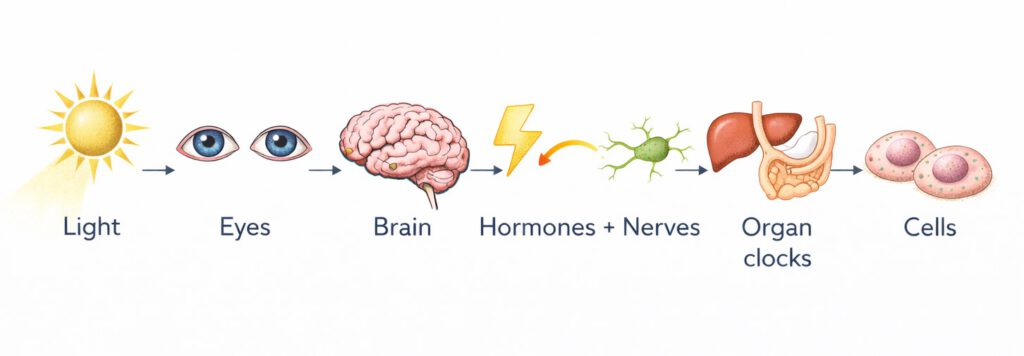
Because the Why we have to sleep post already explained about light, about your eye cells and your brains clock. It will now be about Hormones here:
“So the light which comes through my eyes into my brain regulates my hormones?”
” Yes, in a way.”
“Which hormones?”
“Let see..”
Hormones travel through our blood, hormones regulate our energy, our mood and how our body is changing over the years. Especially 2 important hormones are affected by how and when we view light. You probably have heard about them ..
Melatonin (the sleep hormone) AND
Cortisol (the wake + stress hormone).
To understand this it is imoportant to know that, your eye cells are able to read the frequency of light in the atmosphere and that bright daylight is rich in short wavelengths:
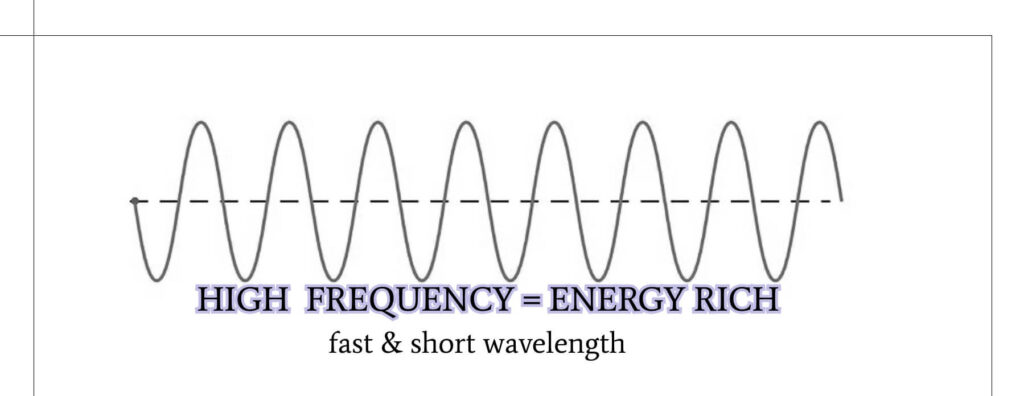
So when you see bright light your eye cells will react to it like this:
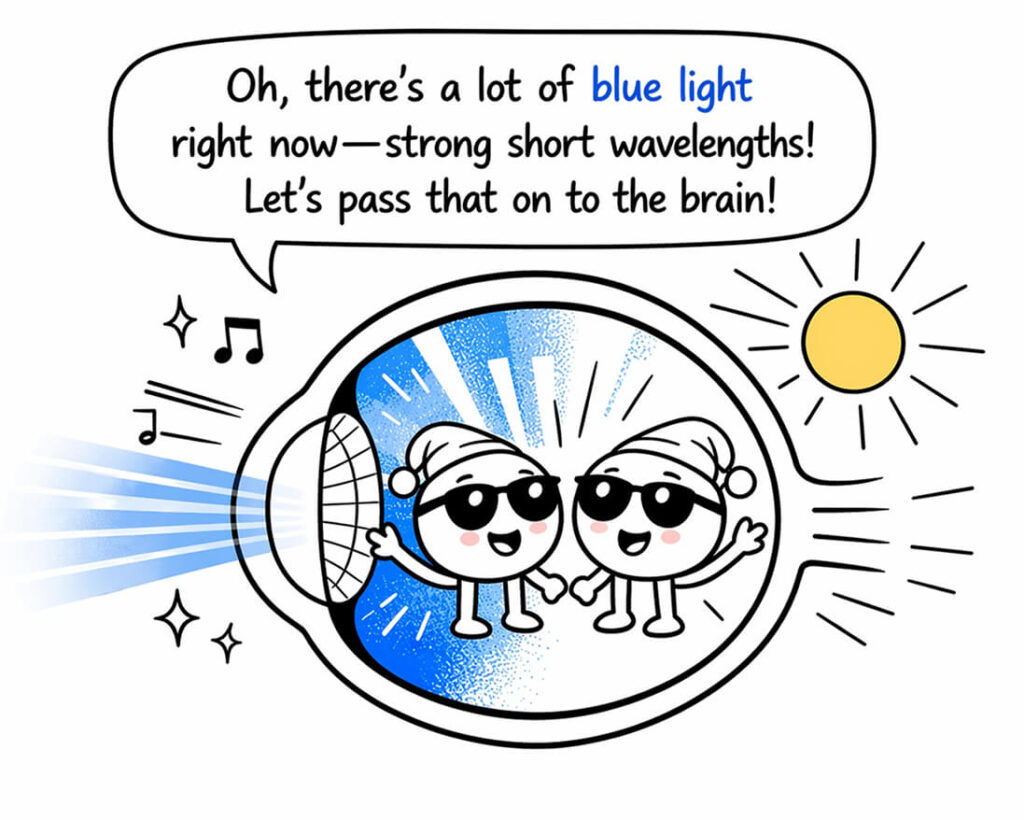
Your Brian spreads the information to your body: Lets go! Wake up. Day has arrived, start your task! And your body will start and…
- … rise alertness
- …rise body temperature
- …increase cortisol
- …synchronise your internal clock for the day and
- …stop the melatonin production
The brighter the light you see is, the stronger is your bodys response to it. To say in a very simple way:
“When you wake up in the middle of the night and you view bright light it will signal your brain it is daytime and your body will want to start doing its day tasks.”
“Is that why, fewing bright light late in the evening and being on the phone at night.. is a problem ?”
“Yes.”
You might now argue: “But I KNOW that it is night!”
“Still, it wont change your bodys reaction to an outside influecne. Your body is a machine.. it is made to work in a specific way and you can not change this with your thoughts.”
Look, maybe this helps: When the sun set and then very very strongly you think about the sun coming back up. Will it? No, there are patterns and rhythms which we can not change by simply thinking about it. There are certain mechanism and wys the world and we humans work and because we studied, we know about this things by today.
Here are a few important things to keep in mind when it comes to the quality of light:
Not every blue light triggers the same, there is a massive difference between artificial and natural light. The strongest indoor light ranges around 100–1,000 lux. Real daylight is about 10,000–100,000 lux. You see, no light is as effective as real sunlight and we are not able to recreate this light artificially. But we can step outside and let it naturally enter our body.
It is vitally important that you get good quality light communicated to your brain clock in the morning, because without enough quality light your melatonin production will not properly turned off and your for cortisol can not start properly.
“We know based on a lot of evidence that if you don’t get your cortisol and melatonin rhythms timed right there are tremendously bad effects on cardiovascular health, dementia, metabolism, diabetes risk, fertility learning and depression. “
It is important to get quality light from outside, only viewing indoor light through a window will not have the same quality.
That’s often why people feel more tired and less active in winter. It is not because they are “lazy,” but because their eye cells do not get enough natural light their “morning time marker” is missing and therefore their body has a hard time to know what time it is and when to feel tired and when to feel awake.
If you wake up and directly look at your computer or your phone or another artificial light, your eye cells will be activated but not in a good way.
“Many positive things happen when we time our clock right. So, what we want to do is to get outside as soon as possible after waking up. To make sure our body can do his work in the best settings.”
“Alright, I know how to properly wake up my body to start my system, but what about turning it off? Can I also use light for that?”
“Yes. You can!”
Let’s quick have a look back to about ~ 1 Million Years ago (1.000.000 years) for understanding something important. Because back then, it was the time where we humans started to use another light source next to sun or moonlight.
We used Fire.
Fire and daylight were the only light sources we humans had, for a long time. Electric light bulbs only established around ~140 years ago (… and I am now doubting that, we ever got well educated about those.)
!INFO:
Fire has about 10 – 100 lx.
Sunlight has around 10.000 – 100.000lx !
Lux is how bright your eyes perceive the light, not its color, not the temperature, not the wavelength.
Sunlight has a full range of light so 400–700 nm:
Ultraviolet light: < 400nm
Blue light: ~400–500 nm
Green light: ~500–570 nm
Red light: ~620–700 nm
Infrared: > 700 nm
Firelight is mostly 600–700 nm + infrared (>700 nm)
Nm is short for a nanometer and used to measure visible light.
The human eye responds to wavelengths from ~ 380 to ~ 750 nm.
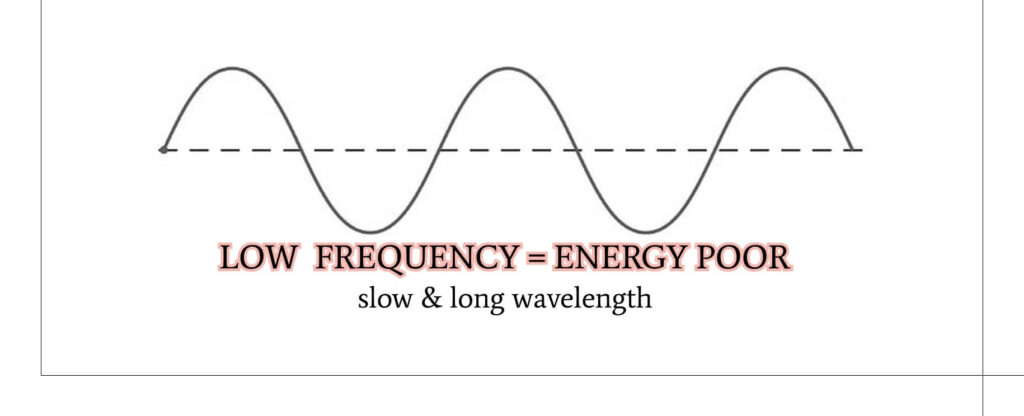
Low frequency, long wavelength light (like fire and very warm lights) signal the body that it is time to relax and wind down and your body will then:
- lower alertness,
- reduce cortisol,
- synchronise the internal clock for sleep
- increase melatonin production
- melatonin release
A beautiful sunset, when the sky turns all red, it is similar to this wavelengths of fire and the cells in your eyes detect it and be like:
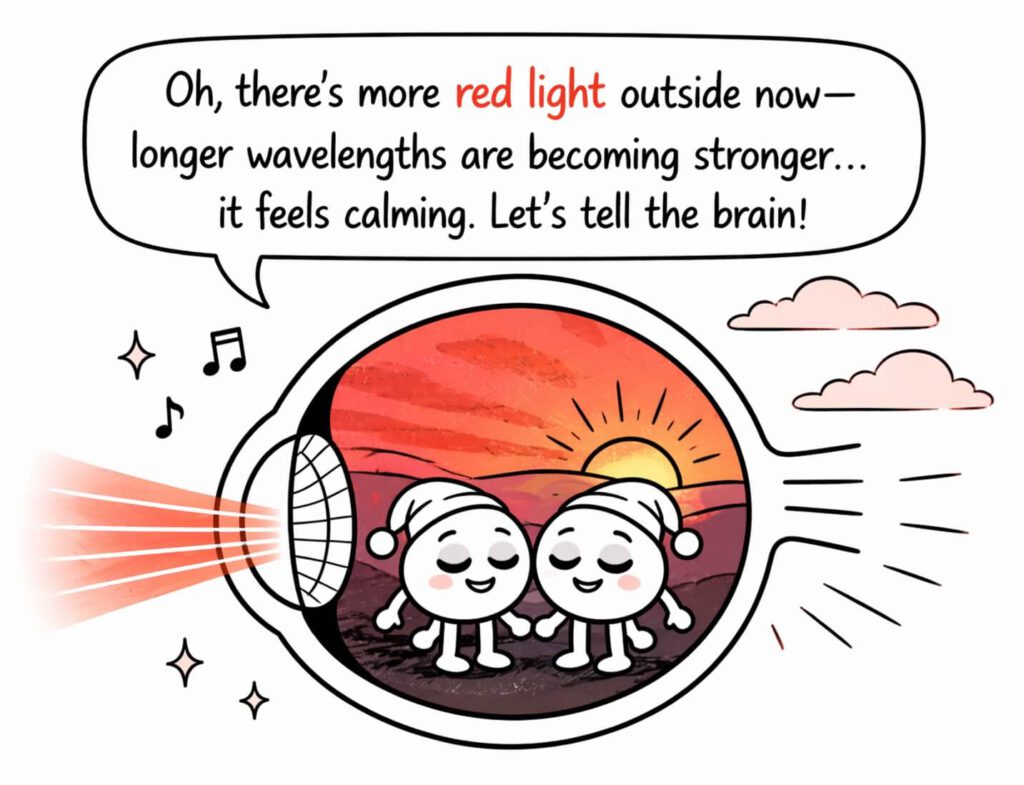
The red light from the sunset and sunrise is a transition-signal for your body that a change is happening. Either to wake up, or to rest and sleep.
Any change, disruptions or misalignments can impair this balance, leading to dis-regulation of hormonal rhythms.
“The daily rhythm of the sun has always been there and it has always been the same. So our hormone system is exactly constructed towards it. Our whole cycle is linked to the solar cycle.”
Interesting Side facts:
- If we would be in complete darkness the cycle would still work. Because after the rise of cortisol (about 12 to14 hours later) melatonin will naturally come up.
- Most of the night owl people are just not getting enough light during the day! It dictates what time you get tired and sets the foundation of proper sleep! “Maybe your brain just didn’t get enough sunlight.”
- Blind people (provided they still have eyes) maintain the neurones which set the clock. Its not about seeing the sun, you don’t have to look in the sun directly! This neurones in your eyes which activate this mechanism get activated by the particular wavelength of light that are present in the atmosphere. They get activated even if they come through cloud cover you don’t necessarily need to see the sun directly to get them startet.
back to OUR hormones now..
“We understand that light either helps or disrupts our hormones Melatonin and Cortisol.”
.. and, what do they actaully do inside a human body?
Cortisol helps you to wake up, to regulate your bodies temperature, your fluid balance, and to keep your blood sugar within healthy ranges.
Shortly before you wake up, your cortisol levels rise naturally by up to 50–60% and makes you feel awake, energetic, and alert. Cortisol slightly increases blood pressure and body temperature.
Melatonin helps you to be tired in the evenings and to get in a state that supports deep, restorative sleep.
Shortly before darkness, your melatonin levels rise naturally, signaling your body that it’s time to calm down, feel sleepy, and get rest. Melatonin slightly reduces body temperature, helps to lower alertness and supports you to fall assleep.
Light (especially bright blue light) reinforces cortisol.
“Therefore watching the sunrise or generally bright sunlight after waking up, supports your body to propperly wake up and get your cortisol rhythm started in the best way! “
Light (especially calm, warm, yellow light) reinforces Melatonin.
“Therefore watching the sunset, dimming lights in the evening and avaoiding overhead lights (because think about it, overhead light in the night is just not natural!)helps your body to calm down and get restfull sleep that night.”
TAKE AWAY:
Cortisol in the morning = good (makes you feel awake)
Cortisol in the evening = bad (makes you feel awake)
Melatonin in the morning = bad (makes you want to sleep)
Melatonin in the evening = good (makes you want to sleep)
“Actually, due to a lot of very badly placed indoor lighting a disruption of this two hormone rhtumns happens faster than you might like and many people have problems due to this.”
- Light disruption produces changes in metabolism. (1)
(1) Metabolism: the three main functions of metabolism are the conversion of energy from food, the conversion of food to building blocks and the excretion of wastes. That is why sleep loss can lead to endocrine diseases like: Weight gain, depression, fatigue, immune weakness, fertility problems and diabetes risk. - The behaviour of viewing blue light in the night (11 to 4pm) invokes the Habenula. (2)
(2) Habenula: A brain region, known as an “emotion control center, which acts as a major bridge between the limbic system and the midbrain. The behaviour of viewing light at night can significantly activate disappointment circuits, reduce dopamine and increase depressive thoughts patterns in the day thats follows - Insufficient exposure to natural light has been linked to SAD. ***(3)
(3) SAD: Seasonal affective disorder, is a type of depression that occurs at specific times of the year often during the darker months. Reduced daylight in winter (or staying indoors) affects circadian rhythms and vitamin D intake.
Now look, because I am not only a fan of research but also of coming to conclusions to make life better. Here are my solutions:
Get natural light exposure after waking up, to set your system correctly. Watch the sunset to tell your body it is evening. Dimm your lights at night to get good sleep and be in balance with your natural rhythm.
“It could be worse, right?
I love you, please do the same.”
Wanda J.
BONUS knowledge:
- Glucose tolerance peaks during daylight and is lower during the darkness cycle
- Melatonin drops at sunrise and rises around sunset
- Cortisol rises just a little later than sunrise
- Sleep deepens at 1:00am
- Body temperature rises at 3:00am
- Through a single sunrise you can set your clock forward or backward by several hours! (Can be healpful to knwo when traveling between time zones..)
Research References:
Dantas, F.M., Oliveira, M.L.P., Luzardo, R., Araujo, J.F. and Silva, A.C. (2025) ‘The role of sunlight in sleep regulation: analysis of morning, evening and late exposure’, BMC Public Health, 25, Article 3362. doi:10.1186/s12889-025-24618-8.
Dijk, D.-J. and von Schantz, M. (2005) ‘Timing and consolidation of human sleep, wakefulness, and performance by a symphony of oscillators’, Journal of Biological Rhythms, 20(4), pp. 279–290. doi:10.1177/0748730405278292.
Dunster, G.P., Hua, I., Grahe, A., Fleischer, J.G., Panda, S., Wright, K.P. Jr., Vetter, C., Doherty, J.H. and de la Iglesia, H.O. (2022) ‘Daytime light exposure is a strong predictor of seasonal variation in sleep and circadian timing of university students’, Journal of Pineal Research, 74(1), p. e12843. doi:10.1111/jpi.12843.
Franzago, M., Alessandrelli, E., Notarangelo, S., Stuppia, L. and Vitacolonna, E. (2023) ‘Chrono-nutrition: circadian rhythm and personalized nutrition’, International Journal of Molecular Sciences, 24(3), Article 2571. doi:10.3390/ijms24032571.
LeGates, T.A., Fernandez, D.C. and Hattar, S. (2014) ‘Light as a central modulator of circadian rhythms, sleep and affect’, Current Biology, 24(10), pp. R461–R473. doi:10.1016/j.cub.2013.06.039.
Rao, F. and Xue, T. (2024) ‘Circadian-independent light regulation of mammalian metabolism’, Nature Metabolism, 6, pp. 1000–1007. doi:10.1038/s42255-024-01051-6.
Huberman Lab (no date) Dr. Glen Jeffery: Using red light to improve metabolism. Available at: https://podcastnotes.org (Accessed: 7 April 2026).
Max Planck Institute (no date) Translational sensory and circadian neuroscience. Available at: https://www.kyb.tuebingen.mpg.de (Accessed: 7 April 2026).
MDPI (no date) Hormonal regulation and circadian processes. Available at: https://www.mdpi.com (Accessed: 7 April 2026).
NCBI (2023) Circadian rhythm and the 24-hour clock. Available at: https://pmc.ncbi.nlm.nih.gov (Accessed: 7 April 2026).
Osmio Water (no date) Sunlight and health. Available at: https://www.osmiowater.co.uk (Accessed: 7 April 2026).