
How the Environment Regulates our Biology
Well, it might sound wired at first but light is actually the reason for why we sleep or why we are awake. Light stimulates us and to be more precise; the presence of light makes us awake and the absense of light makes us sleepy.
Yes, you are right, due to artificail lighting it can be quite difficult for our body to understand if it is day or night.
In this article I am aiming to prove the impotance and the impact of the outside world (environment) for our inside world (body).
Let’s jump into it:
Firstly it is important to understand that our body is regualtet by what happens outside of it. What do I mean by this. Well, you know the sun, don’t you? The massive luminous star of hot gas in our universe. The most powerful source of energy we know and without we would not exist.
I think to look at our solar system can help to understand the system of a human body as well. I prepared 2 Grafics, just see how much you can make sense of them.
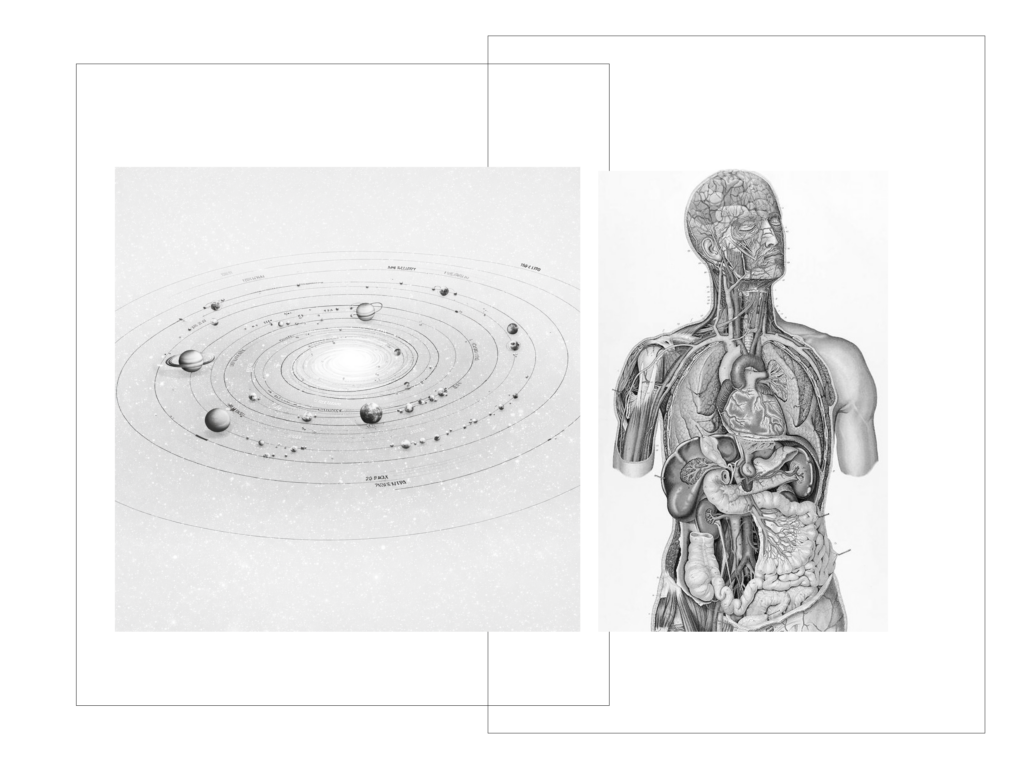
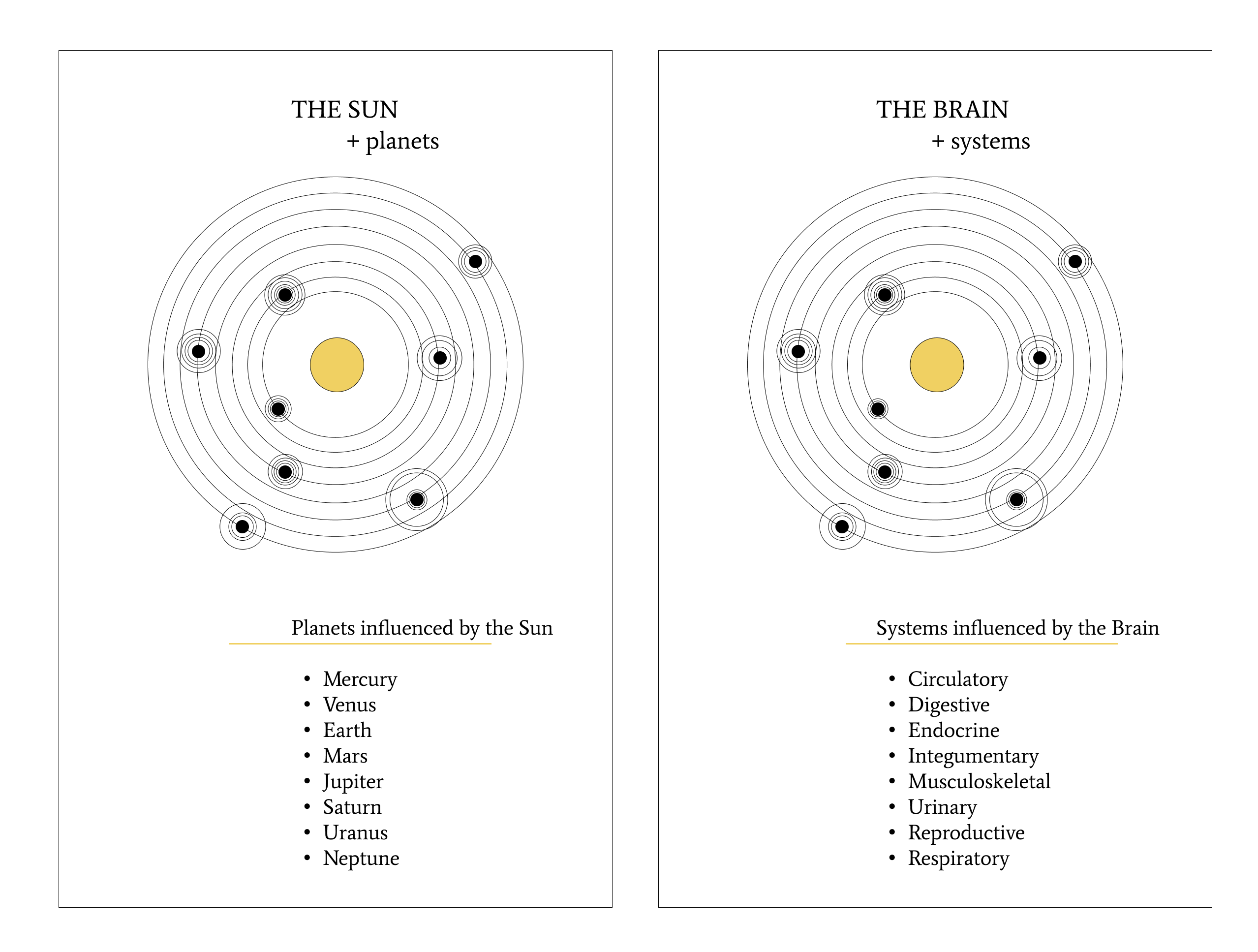
To clarify: I do not mean to say that the solar system has something to do with the system your body carries. It is designed to help you visualise how complex your inside is and to understand that, if you want to see inside a human you need a look deeper and preferably use tools, same as you need tools to see all the planets and stars of our solar system.
Secondly it is to visulise that, any changes in the Sun’s heat, speed, or rotation would profoundly impact the entire solar system and therfore the dynamics across all planets and that any changes in your brain can have similarly catastrophic effects for the whole body and its dynamics.
“Understand your own system before going any further. Many people live a whole life without realizing how they function.
Research References:
Foster, R. G., & Kreitzman, L. (2014). The rhythms of life: What your body clock means to you! Experimental Physiology, 99(4), 599–606. https://doi.org/10.1113/expphysiol.2012.071118.
Cajochen, C., Zeitzer, J. M., Czeisler, C. A., & Dijk, D. J. (2000). Dose-response relationship for light intensity and ocular and electroencephalographic correlates of human alertness. Behavioural Brain Research, 115(1), 75–83.https://doi.org/10.1016/S0166-4328(00)00236-9
Panda, S. (2016). Circadian physiology of metabolism. Science, 354(6315), 1008–1015.https://doi.org/10.1126/science.aah4967
Roenneberg, T., & Merrow, M. (2016). The circadian clock and human health. Current Biology, 26(10), R432–R443. https://doi.org/10.1016/j.cub.2016.04.011